
Most tradespeople do not just work in one town. A plumber based in Welshpool might cover Newtown, Oswestry and Shrewsbury. An electrician in Telford might travel across half of Shropshire. But if your website only talks about your home town, Google has little reason to show you to someone searching for an electrician twenty miles away.
Service area pages, sometimes called location pages, are one way to fix that. Done well, they help customers in each town see that you work there. Done badly, they are thin copies that search engines ignore and that can do more harm than good. This guide explains the difference.
How local search works for trades
There are two places you can appear for a local search: the map results, driven mainly by your Google Business Profile, and the ordinary search results underneath, driven by your website. Google says local results are based mainly on relevance, distance and prominence. Your Business Profile can list the areas you serve, but distance from the searcher still matters a great deal for the map, which is why your website matters for towns further from your base. Our Google Business Profile guide covers the map side; this article focuses on your website.
Good pages versus doorway pages
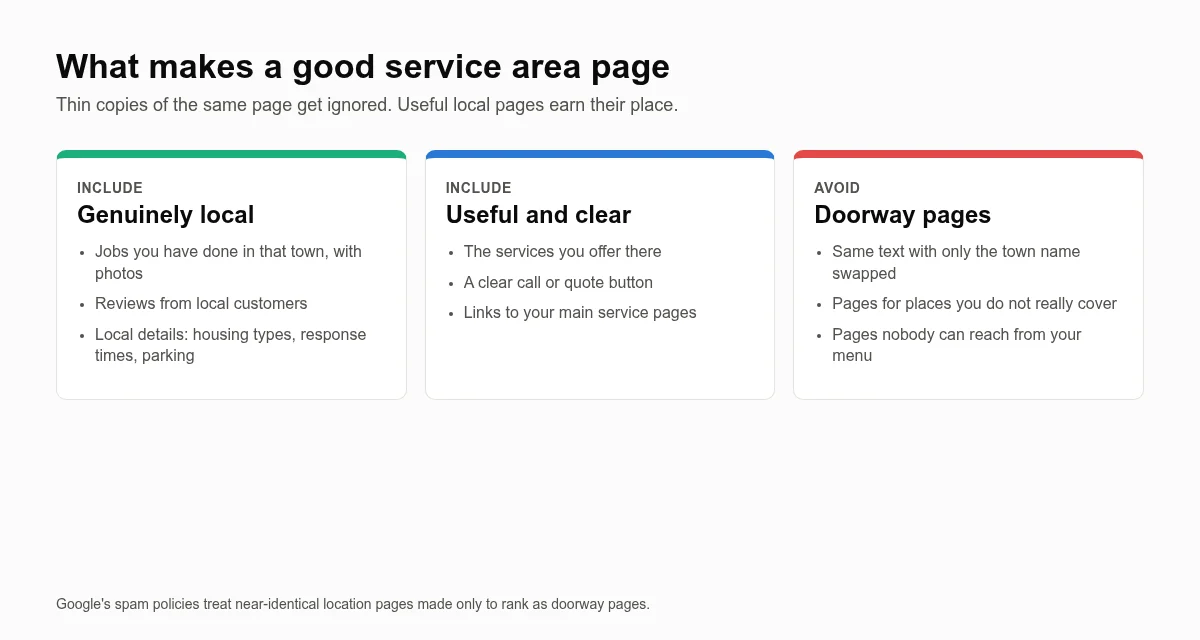
Google’s spam policies describe “doorway” pages as pages created to rank for similar searches that send users to the same place, and give the example of multiple pages targeting specific regions or cities that funnel users to one page. The classic version is twenty pages with identical text where only the town name changes. They add nothing for the reader and can count against your site.
The test is simple: would a customer in that town find the page genuinely useful, even if search engines did not exist? If the answer is yes, you are on the right track.
What to put on each page
- A clear opening that says what you do and that you cover that town, for example “Emergency plumbing and boiler repairs in Newtown and the surrounding villages”.
- Real local work. Two or three recent jobs in that area, with photos and a sentence about each. Nothing proves you work somewhere like evidence that you do.
- Reviews from customers there. If a review mentions the town, show it on that page.
- Useful local detail. Typical housing in the area, common problems you see, how quickly you can usually get there, or which villages you cover around it.
- The services you offer there, with links to your main service pages.
- A clear call to action: a tap-to-call button and a short quote form.
How many area pages should you have?
Start with the towns that matter most to your business: the ones you get the most work from, or want more work from, and can genuinely cover. Three to six strong pages beat thirty weak ones. Add more only when you have real content for them, such as jobs and reviews from that area.
| Situation | Suggested approach |
|---|---|
| You cover a few nearby towns | One strong page for each main town |
| You cover many small villages | Group them by area, for example “North Powys”, and list the villages |
| You only have work examples from a couple of places | Start with those and add more as you build up local jobs |
| You list towns you rarely visit | Leave them out; unhappy customers from out of area do not help |
Make the pages easy to find
- Add an “Areas we cover” page that links to each town page, and link to it from your menu or footer.
- Link from relevant service pages and blog posts to the matching area pages.
- Give each page a unique title and meta description that mention the service and the town.
- Keep them fast and mobile-friendly. See our guide to Core Web Vitals.
Google’s SEO starter guide covers titles, descriptions and internal links in more depth.
Keep them fresh
Area pages are not a one-off job. Every few months, add a new local job, a fresh photo or a new review. It keeps the page useful and gives you a reason to share it. Asking customers to mention the town in their review helps too; our guide to getting more Google reviews explains how to ask without breaking the rules.
Let us build them for you
Savvy Saver builds websites for tradespeople with genuine service area pages included, and keeps them updated as part of our plan. Take a look at our web design for tradesmen, plumbers and electricians, see our local SEO service, or get in touch.