
Ask three web designers to quote for the same small business website and you can get three very different numbers. One quote is a single upfront fee, another is a monthly plan, and a third is a low headline price with extras added later. It is hard to compare them unless you know what you are actually paying for.
This guide breaks website costs down into the parts that sit behind any quote, so you can compare like with like and avoid surprises.
The three kinds of website cost
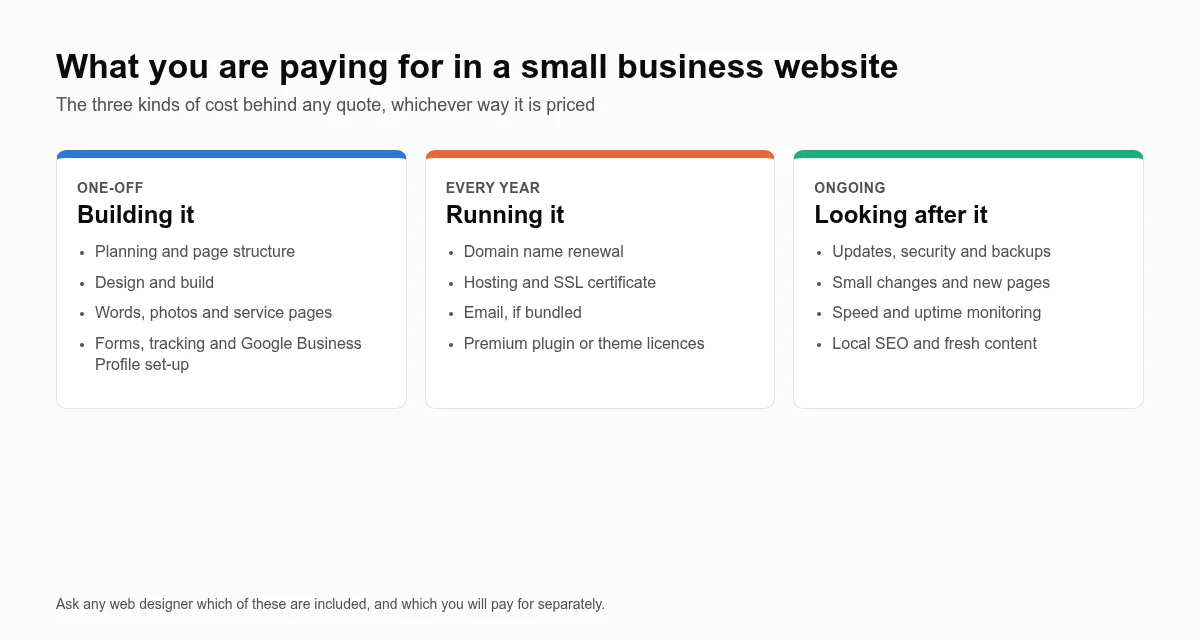
1. Building it (one-off)
This is the work to plan, design and build the site. The main things that change the amount of work are:
- Number of pages. A trade business usually needs a page for each main service and often for each area it covers, not just a homepage.
- Content. Who writes the words and supplies the photos? Copywriting and photography take time and are often where quotes differ most.
- Features. Quote forms, booking systems, galleries, online payments and integrations with other software all add work.
- Template or custom design. A well-chosen template can be quick and effective; a fully custom design takes longer.
- Set-up extras. Analytics, Google Business Profile, basic SEO and moving content from an old site.
Our list of what a trade website should include is a useful checklist to compare quotes against.
2. Running it (every year)
Every website has some unavoidable running costs, whoever builds it:
- Domain name, renewed every year or every few years
- Hosting, which keeps the site online; cheap shared hosting and good managed hosting perform very differently
- SSL certificate, so the site loads over https; often included with hosting
- Business email, if it is bundled with the domain or hosting
- Licences for premium themes or plugins, which usually need renewing to keep receiving updates
3. Looking after it (ongoing)
This is the part people forget. A WordPress site needs regular updates, backups and security monitoring, and most businesses want small changes from time to time. Our WordPress maintenance checklist lists what is involved. Some owners do it themselves; many pay for a care plan. Speed matters too: a slow site loses visitors, and Google’s Core Web Vitals measure the experience people get.
Upfront fee or monthly plan?
| Upfront build fee | Monthly plan | |
|---|---|---|
| Cost at the start | Higher | Lower or none |
| Ongoing costs | Hosting and care often extra | Usually bundled into one payment |
| Changes and updates | Often charged per job | Often included within limits |
| Who owns the site | Usually you, once paid | Check the contract carefully |
| Best for | Businesses happy to manage the site or pay as they go | Businesses who want it handled for a predictable cost |
Neither model is better in every case. What matters is the total cost over two or three years and what is included in it.
Costs that catch people out
- Domain registered in the designer’s name. Make sure the domain is registered to your business, so you can move it later.
- Low first-year hosting prices that rise sharply on renewal.
- Every small change billed separately, which adds up quickly.
- Minimum contract terms and exit fees on monthly plans.
- No maintenance at all, leaving an out-of-date site that is more likely to be hacked and costs more to fix.
- Legal basics left out, such as a privacy notice and proper handling of contact form data. The ICO’s guidance for organisations explains your data protection responsibilities.
Questions to ask before you sign
- What exactly is included in the price, and what costs extra?
- Who writes the content and supplies the photos?
- Who owns the domain, the website and the content?
- What are the yearly running costs after the first year?
- Who handles updates, backups and security, and how quickly are problems fixed?
- How are small changes handled and charged?
- Is there a minimum term, and what happens if I want to leave?
- Will the site be built with search in mind? Google’s SEO starter guide is a good reference for what that should mean.
How Savvy Saver prices websites
We keep it simple: one clear monthly plan that covers the build, hosting, updates, security and changes, so you know what you are paying and nothing is hidden. See how it works, read about our website maintenance package and growth partner plan, or get in touch for a straight answer about your business.